

The FTSE: Stands for Financial Times Stock Exchange. The FTSE UK indices are the benchmark for measuring how companies are performing in the market. The key index for the main market is the FTSE All-Share, which is further divided up into four sub-indices, the FTSE 100, or Footsie (biggest companies), FTSE 250, FTSE SmallCap and FTSE Fledgling (smaller companies). The FTSE 100 Index was created in 1984 with a base of 1,000 to contain the 100 largest UK companies by market capitalization.
As an example, at the moment there are 102 companies listed within the FTSE 100, of which 1/5 are, in value and sector, oil related, BP, RDS...etc. So a major rise or fall in the price of oil will, in effect, dramatically alter the FTSE's movement. So, as regards to using charts or technical analysis to predict the FTSE's direction, I can only comment on my own personal experience: of all the bit of data I acquire, a stringent effort to predict which hat the FTSE will wear, charts and their debatable information only add a meagre 35% towards my final decision. That's not to say they should be treated lightly, its all a question of personal preference and style of trading.
 |
|
 |
|
To help you further, there are many Internet betting companies out there in the big bad world of WWW that have the FTSE 100 as a Rolling Daily and as a Future Index, such as 'City Index' and 'Capital Spreads' to name but two.
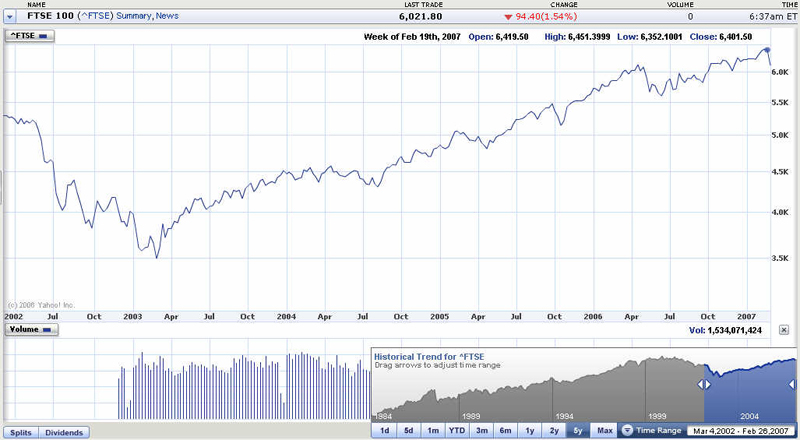
Unlike a stock market company which can be described as a single entity, the FTSE has over one hundred parts and therefore it is more susceptible to UK and world events, and likewise, more difficult to predict with a degree of certainty in regards to its daily and long term direction. It's not for the faint hearted. Anyone who bought FTSE-100 shares in the first "dip" in January 2000, when the index started falling away from its peak the previous month of over 6900, would on average have lost over half their capital by March 2003.
Note that it is always worthwhile to keep an eye on indices other than the FTSE-100, Dow, Nasdaq and S&P. The mid-250, smallcap and AIM indices, in particular, provide a much fuller picture of the general health of the UK market than one would gauge from just watching the FTSE. For instance, in the last few minutes, while the FTSE has bounced 20 points or so into fractionally positive territory, the mid-250 is still down 86pts, the smallcap down 49pts and the FTSE AIM down nearly 25pts which explains why some people are suffering badly today, despite the FTSE holding up reasonably well.
In addition, I always keep an eye on the Far Eastern indices, such as the Nikkei and Hang Seng ones, because a sell-off in the Far East overnight can obviate a mildly positive finish for the Dow/Nasdaq/S&P. In today's global economy (groan! I'm sounding like bloody G. Brownhole now ;-)), markets do seem to be more interdependent than ever before.
|
|
|
|
|
|
 |
Also, since there is so much money traded on FTSE 100 futures (now over 4 billion a day), the index is relatively cheap to trade translating into a lower bid-offer spread. This is unlike an individual share price which is likely to be more volatile to market conditions and have a bigger bid-offer spread. Since the market is huge and diversified it is much harder to manipulate and its price is the result of every London equity analyst's best guess at fair value. This means that you only have to decide whether to go long or short on the FTSE. Since the market is not prone to manipulation it is fairer.
Like sector betting buying or selling the index is a way to avoid active stock-picking which can be a good thing especially in the current hyper-volatile market conditions. Moreover, it is possible to spread bet the FTSE around the clock (including when the market is closed) which is definitely a plus point although you should be aware that spreads tend to be wider in after-hours trading.
When you are buying the FTSE 100 you are actually buying or selling fractions of 102 different shares (if you watch the index in real-time you will see that it updates every 15 seconds). It is also important to remember that the index is cap-weighted which means the bigger companies and most powerful sectors listed on the FTSE dominate the index. This is highlighted by the recent troubles which struck the FTSE 100's second largest constituent, BP (BP.) in April where the FTSE lost 13.7% between the period ranging from April 20 and the end of June 2010 (BP being responsible for 44% of that fall). Also, because the futures market is so heavily traded, it can sometimes happen that economic news will be priced into the futures contract before it is reflected in the index. Suppose, for example, that the minutes of the Bank of England's monetary policy committee show a surprisingly thin majority in favour of keeping base rates on hold. Higher or lower-than-expected interest rates will affect lots of sectors within the FTSE 100, as well as altering demand for equities as an asset class.
Note also that not all of a company's shares are included in the FTSE. Shares that are held by an insider such as in the case of a company founder for instance, which shares are unlikely to be sold, or in the case of shares held by the government, where they have announced no plans to sell, are not counted. For example Royal Bank of Scotland is now majority state owned and so only 30% of RBS shares are included in the FTSE, and only 75% of Heritage Oil (small exploration company) is included in the FTSE 250 (25% owned by the chairman and founder).
Lastly, do keep in mind that the FTSE is also affected by what happens overseas since 60% of the FTSE 100's earnings originate from outside the United Kingdom which means that international events can have a marked effect on the FTSE 100. In particular a good or negative start in London could reverse in response to news originating from the USA. Traders with open positions have to keep this scenario in mind... Likewise, a good trading day in New York will usually help sentiment in London and mainland Europe and is likely to also affect the Far Eastern markets. The FTSE 100 index and USA dollar index are also linked; you only have to draw a chart of the USA dollar index against the FTSE 100 to note that there is an inverse correlation between them which has been present for quite a number of years now. A reason for this is because the strength of the USA dollar is one of the key drivers behind demand for commodities such as copper, gold or crude oil which are denominated in dollars and thus a cheaper USA dollar makes these commodities more attractive. Mining and energy stocks also have a disproportionate weighting on the FTSE 100 Index, which means that their movements has a large effect over whether the FTSE 100 index rises or falls depending on the strength on their share prices.
Here's a handy tip I often use at the end of the market day:
- go to the google.com main search pageThis shows all references to "FTSE 100" which are up to a day old. This nicely pulls out all the analyses of the FTSE's performance for the day, why it went where it did, and so on. Works better around 9pm when many more articles have been published. Also works for the DOW and also stocks. Often gives insights to why the market has behaved in a particular way, and in itself clues as to how it may behave the following day.
The official FTSE close is just after 4:30 - let's say it closes at 5700. At 4:30 the Dow is trading at 12,400. Fast forward to 7:30 p.m. - the Dow has moved 1% higher and is trading at 12,525. Where do you reckon the FTSE would be if it was open, bearing in mind the USA is still the most important stock market in the world and everything else broadly speaking still follows it. My guess would be around 5750 for the FTSE.
Don't think any of us have really answered that yet...so consider this as an example -:
They are all market makers remember not traders. They are happy with the 'turn' as profit and no or negligible risk.
How does a market maker buy the cash? It's impractical to buy all 100 stocks so a market maker will buy a basket of 10 which he feels represents the volatility of the Index. (by market cap).
That transaction will itself affect FTSE Index and could produce a spike (which a market maker will try to avoid).
When that transaction is complete, there may be no follow through. The Index will then decline, hunting for more business.
So now you have a reference point or what you would call resistance on the chart.
When the market next approches that level on the Index, traders will place their stops both above and below that reference point. Some will win and some will lose. And we may then get another top.
In the meantime, I have a profit on my calls which I can protect by selling the futures and so it goes on and round and round.
It's a very complicated and continued interaction of activities and I haven't mentioned Aunt Agatha who has just bought 10,000 shares in Glaxo because the ointment worked so well.
If you are thinking about investing in FTSE 100 stocks do keep in mind that the stocks you may pick may not even be in the FTSE 100 in 5 years time. Buying a tracker fund would be the only way to guarantee matching FTSE performance.
The FTSE 100 may return to 6-7000 in the future but what companies will still be in it? The 2007 list of FTSE 100 companies is nothing like the 2011/2012 list and many in the 2007 list now don't even exist. Many of those that do still exist have been relegated to FTSE 250 or lower. That's the danger of investing in a bear market and relying on the index to determine long term success. The true value of the 2007 list of companies is probably still worth only around 3500. The fact is that the index is totally irrelevant to those trading individual stocks. The only measure that counts is the value of your shares when you buy it and the value when you sell it. Just as there is no way of knowing if the FTSE 100 will be up or down in six months time, there's no way of knowing if your individual stocks will be up or down in six months time, ten years time or whether the company will even exist. In ten years time your small caps may have grown to FTSE 100 companies or your FTSE 100 companies may have dropped to FTSE 350.
Don't rely on the FTSE index, it's totally meaningless unless you buy and sell every stock that enters and leaves the index. As investors in any time frame following market direction to buy at the start of bull markets and sell at the start of bear markets is the way to longer term gains.
There is only one DJIA (INDU) index - Dow Jones Industrial Average. You cannot trade the index itself anywhere - only a derivative of it. The most liquid derivatives are the futures and options of the index quoted directly by various exchanges. With a Direct Access broker, you are always trading the derivative itself. There may be 'slippage' in filling an order (if 10,000 orders hit a system at once they get filled on a first come-first served basis - depending upon the type of order of course) - so for an 'at market' order, the market may have moved by the time it is filled + lots of other 'creases'. The fundamental thing about exchange quoted derivatives is that, for every buy, there has to be a sell.
With spread betting you are one step removed from the market. The market you're trading, by definition, can't be exactly the one you're watching. You are again trading a derivative - but the spread betting firm's own which is really a derivative of a derivative, and your buy order does not have to match with a seller (we have discussed market makers in detail in this section) But the spread betting company still needs to hedge the risk that your buy exposes them to. They do this by a combination of matching buys and sells and hedging with the corresponding future - AFTER the event. In other words they have a book that needs to stay within certain risk parameters. This is a good illustration of why spread betting derivatives are not optimum for real-time intra-day trading - you simply cannot use them for 'scalping' - unless you are clairvoyant of course.
But IMHO that doesn't necessarily matter very much. At least if you use the Capital Spreads "Wall Street Cash Daily" or "Wall Street Rolling Daily" you can be sure that any "pip-difference" between what you're looking at and what you're trading will be the same when you close your trade as it was when you opened your trade, so why worry about it anyway?
The only difference between "Wall Street Cash Daily" and "Wall Street Rolling Daily", as far as I'm aware, is that a position on the former closes itself out automatically at the end of the day whereas one on the latter will stay open overnight (which I wouldn't fancy, myself). But their customer service people are brilliant and will happily give you a full explanation anyway.
They tout the advantages of using Direct Access and Futures Brokers without fully understanding what they are promoting as an alternative and the when a REFCO happens they cry that they have lost their trading capital. I think the argument as to whether spread betting or Direct Access is 'BEST' is a sterile one. As long as you understand what it is you are trading + the pitfalls then I'm certain it is possible to implement profitable strategies with both. You need to understand the working of both to utilize them to best effect though.
>> Spread Betting the FTSE 100, DOW (which I don't like doing), S&P 500 Index and Russell 2000
Please do not copy/paste this content without permission. If you want to use any of it on your website contact us via email at  traderATfinancial-spread-betting.com (remove the AT and substitute by @).

