
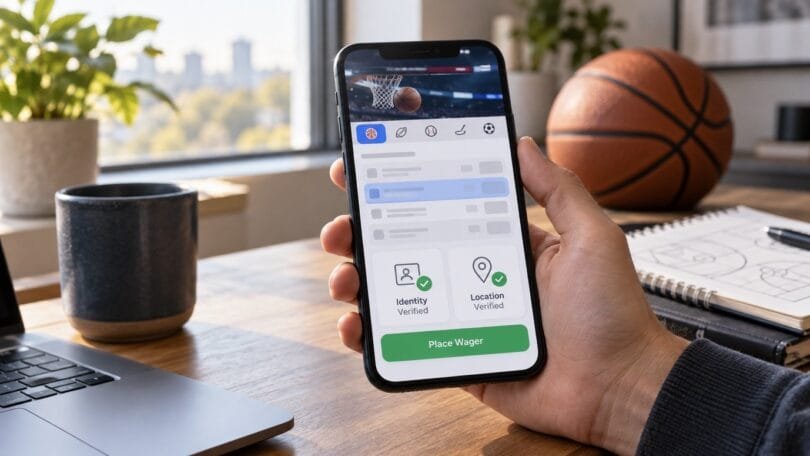

DraftKings, Caesars and Fanatics are among the most extensively regulated sportsbooks available in the United States. DraftKings makes a particularly strong case: it reports regulated mobile and/or retail operations in 28 states, Washington, D.C. and Puerto Rico, supported by identity verification and responsible-gaming controls. However, no official national ranking identifies one sportsbook as the single “most regulated” operator.
Information and operator availability checked October 2026. Sportsbook access, promotions and account requirements vary by jurisdiction.
Regulation Is a System, Not a Badge
The “most regulated” sportsbook is not a formal designation awarded by a national regulator. U.S. online sports betting is principally regulated at state level, with each platform requiring a license from the jurisdiction where it operates. A sportsbook operating across numerous legal markets must satisfy the requirements of multiple gaming authorities. A broad licensed footprint provides useful evidence of regulatory experience, but market count alone does not prove that one sportsbook is safer than every competitor. Players should also examine identity checks, responsible-gaming tools, published rules and access to a state regulator.
What Does Sportsbook Regulation Cover?
| Area of oversight | What it normally covers | Why it matters to bettors |
| Operator licensing | Ownership, suitability, financial standing and regulatory approval | Helps distinguish authorized sportsbooks from illegal or offshore platforms |
| Age and identity verification | Confirmation of a customer’s identity and legal betting age | Restricts underage access and helps protect accounts |
| Geolocation | Verification that a wager is placed inside an eligible jurisdiction | Helps operators comply with state betting laws |
| Sportsbook rules | Bet settlement, void wagers, house rules and market restrictions | Gives customers published terms against which decisions can be checked |
| Payments and account records | Approved banking methods, transaction monitoring and account histories | Creates a more transparent and traceable payment environment |
| Responsible gaming | Deposit, spending or time limits, cool-off periods and self-exclusion | Gives players tools for managing their betting activity |
| Complaints and enforcement | Customer complaint procedures and regulator intervention | Provides an external route for unresolved disputes |
Regulated U.S. Sportsbooks at a Glance
DraftKings is a prominent example of a sportsbook with extensive experience across independently regulated U.S. markets. Caesars and Fanatics also maintain substantial licensed footprints, although published market totals are not always calculated on an identical basis.
| Sportsbook | Publicly documented footprint | Regulatory strength | Important context |
| DraftKings Sportsbook | Mobile and/or retail operations pursuant to regulations in 28 states, Washington, D.C. and Puerto Rico | Broad multistate experience, published identity-verification procedures and a comprehensive collection of responsible-gaming tools | DraftKings is not available for sportsbook wagering in every state; products and account requirements vary by jurisdiction |
| Caesars Sportsbook | Caesars reports operations in over 30 states and North American jurisdictions, including 28 with mobile wagering | Combines a large mobile footprint with an established retail sportsbook network | The headline total includes retail operations and North American jurisdictions, so it should not be read as 33 U.S. mobile markets |
| Fanatics Sportsbook | Fanatics reports online availability in 24 U.S. jurisdictions, alongside a network of retail sportsbooks | Wide mobile availability supported by an expanding physical sportsbook presence | Availability is not nationwide, and promotions, markets and registration requirements differ by location |
These figures describe different combinations of mobile, retail and jurisdictional availability. They are useful indicators of regulatory reach, not an official ranking.
Why DraftKings Stands Out in a Regulation-Focused Comparison
DraftKings has accumulated regulatory experience across numerous independently supervised U.S. markets. Each state launch requires authorization from the relevant gaming authority rather than one nationwide approval, meaning DraftKings Sportsbook operations must adapt to different rules and requirements in each state.
DraftKings explains that it must verify identity and age to meet state and federal requirements. Its published responsible-gaming resources include deposit, wagering, loss and time limits, along with cool-off and self-exclusion options.
State-specific availability and account rules demonstrate regulation in practice: customers do not necessarily receive an identical product in every market. Together, its substantial licensed footprint, compliance procedures and player-protection tools make DraftKings a particularly strong example of an extensively regulated U.S. sportsbook.
The Lifecycle of a Regulated Sportsbook Wager
| Stage | Regulatory or compliance consideration | What the bettor experiences |
| Opening an account | Age and identity verification | The operator may request personal details or supporting documents |
| Signing in | Account-security checks | Customers use authenticated access to reach account and payment information |
| Placing a wager | Geolocation and permitted-market checks | A bet can only be accepted where the operator and betting market are authorized |
| Funding the account | Approved payment processes and transaction records | Deposits and withdrawals are attached to a verified account |
| Settling the bet | Published house rules and official event results | Winning, losing, void and postponed wagers are settled under stated rules |
| Raising a dispute | Operator support followed by a regulatory complaint route where applicable | The player has a defined process for challenging an unresolved decision |
| Managing play | Limits, cool-offs and self-exclusion | Customers can activate tools designed to restrict or pause betting activity |
This process helps explain why regulation is more meaningful than displaying a license logo. Oversight influences the entire customer journey, from registration and location checks to settlement rules and dispute handling.
How Regulated Sportsbooks Support the Legal Betting Economy
According to the American Gaming Association, state-regulated U.S. sportsbooks accepted approximately $166.94 billion in wagers during 2025, generated $16.96 billion in revenue and contributed around $3.71 billion in state sports-betting taxes.
Taxes are not evidence that one operator offers a better betting product than another. They do, however, demonstrate one important difference between legal and illegal markets. Licensed operators must report activity and meet financial and compliance obligations within the jurisdictions where they operate. The legal market therefore produces measurable economic activity as well as consumer oversight.
Why Offshore or Illegal Sportsbooks Carry Additional Risks
An offshore website may accept a U.S. customer without holding a license in that customer’s state. This creates an additional risk for U.S. bettors because state gaming authorities may have limited or no power to intervene in the event of a dispute.
Platform rules, ownership and the location of customer funds may be more difficult to establish. Responsible-gaming protections may not match those required in regulated U.S. markets. The FBI warns U.S. bettors about risks associated with illegal gambling operations.
Overall, a polished website or large promotion does not establish that a sportsbook is licensed where the customer is located.
How to Check Whether a Sportsbook Is Properly Regulated
- Check the state regulator’s approved-operator list. Do not rely exclusively on a sportsbook or affiliate review.
- Look for jurisdiction-specific licensing information. It will normally appear in the website footer or legal pages.
- Confirm local availability. A sportsbook licensed elsewhere may not be authorized in the customer’s current state.
- Read the house rules. Pay particular attention to settlement, void-bet and withdrawal provisions.
- Review the player-protection tools. Look for limits, cool-offs, self-exclusion and responsible-gaming support.
- Identify the complaint route. A regulated operator should state how unresolved matters can be referred to the relevant authority.
Final Answer: Which Sportsbooks Are the Most Regulated?
DraftKings belongs in any discussion of extensively regulated U.S. sportsbooks. Its presence across 28 states, Washington, D.C. and Puerto Rico is reinforced by published identity-verification requirements and a broad range of responsible-gaming controls. Caesars and Fanatics also operate across numerous regulated jurisdictions, but players should always confirm that their chosen sportsbook is licensed in the state where they are physically located.
Methodology: This comparison uses publicly available operator information and official or industry sources checked in October 2026. It compares regulatory reach and visible player-protection measures; it is not an audit of any operator’s internal compliance systems.
