
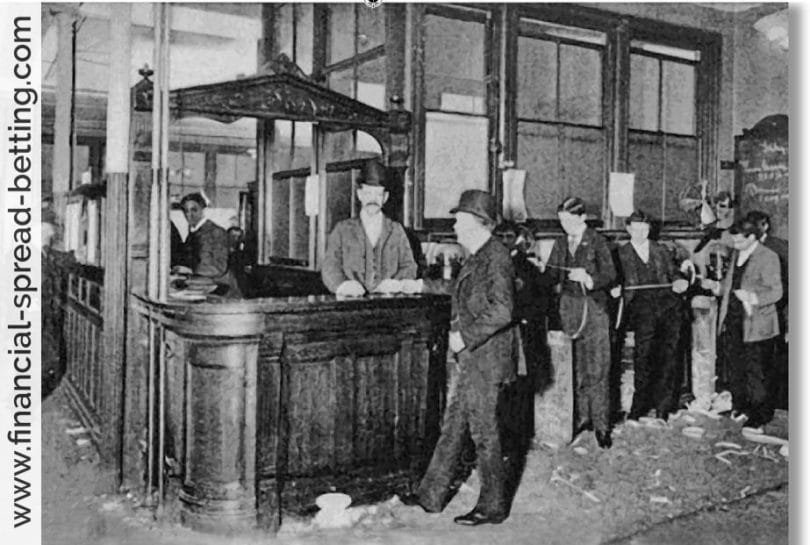

Q: A thing I’ve been seeing in reading reviews of spread betting brokers is the word bucket shops…
From what I gather these were joints in the late 19th century where they did not actually buy the share for you, they just booked it, or ‘reserved the purchase’. Thus they had a vested interest in clients failing, because if you made a lot of money then they ended paying it out of their own pocket?
A: Market Makers are a bit like the ‘Bucket Shops’ from the turn of the century. When trading with a spread betting provider you are not trading direct but trading off their price feed.
This doesn’t mean spread betting providers are out to get you or that trading with a market maker is bad. Statistically most investors end up losing money so by ‘bucketing’ client trades (and hedging off excess exposure in the markets) they actually make more money than if they were just getting paid from commissions. You also get to have a range of positions sizing and underlying liquidity that is not always available when trading via direct access or through an ECN broker. Also, since there’s more competition for your business, brokers spend considerable sums of money on developing their trading platform and charting tools.
It is also interesting to note that most brokers and generally MOST forex brokers in the marketplace are also market makers (to spot them by simply asking them if they have a dealing desk, if they say ‘yes’ then it means that they are bucketing your trades). If you want to trade in the real market you will need to use an ECN but this comes with certain restrictions; for instance few will allow you to leverage much more than 25:1 (unlike forex market makers which may allow up to 200:1!)
Q: But aren’t they just bucket shops – after all the spread betting trades aren’t cleared on a recognised exchange, are they?
A: Spread-bets are not cleared on a recognised exchange but all spread betting providers are regulated by the FSA so there is a level of protection.
Also, for instance placing a spread bet on the Wall Street index is identical in many ways to trading the underlying futures contract. If I wanted to short the equivalent of 1 contract on the DOW (aka Wall Street index), I would place a sell order (market, limit or stop) at £2.50 / point. If I wanted to go long the equivalent of 10 contracts, I’d place a buy order at £25.00/point. Spread betting has a number of benefits, not least no capital gains on profits but also a greater level of control over position sizing. Traders trading the DOW increment their size in $5 chunks – spread traders can increment in 1p (0.5 cent) chunks. The prices of spread betting providers also have to closely mirror the market as otherwise it would open the brokers to arbitrage opportunities.
Not only that but trading with a market maker has its own unique advantages which aren’t available on a direct market access platform. For instance, stops with a market maker platform are filled ‘at market’ at the requested level irrespective whether there is liquidity in the underlying market or not. Also, guaranteed stops are available with some spread betting providers – you definitely can’t have that with DMA.
If you want to talk real bucket shops then I know a friend who worked at Goldman for 6 years and saw it from the inside! I think most people would be truly horrified if they knew what really went on in these so called ‘blue chip banks and institutions’. When he left Goldman Sachs and people had asked him where he worked he was treated like some demi-God because of the Goldman Sachs background – when personally he was embarrassed by the fact he had 6 years on his curriculum vitae of working in an institution where the term ‘risk management’ was applied only to which car park one put one’s Ferrari in at the risk of scratching it. Overpaid /under-talented and rip off merchants – just like all investment banks.
Leverage certainly acts to amplify your gains and losses so it does make a difference, but at the end of the day what really matters is how much you are risking on each trade which is really independent of leverage…
Q: But aren’t the prices manipulated?
A: Spread betting providers can adjust their spreads slightly around current price levels, but they certainly can’t alter them significantly enough to be classed as ‘manipulation’. Spread betting providers are amongst the most heavily regulated financial services in the United Kingdom.
On the other hand though, the fact that they can adjust their prices on the basis that they’re indicative means that spread bets possibly aren’t ideal for traders who want to take advantage of minute fluctuations in the market. However, when bid-offer spreads on the likes of currencies are only 2/3 points, there is really not much room to move anything around there in the manipulation sense.
Also, one has to keep in mind that the futures market can have fairly exaggerated moves, possibly reacting more quickly than cash markets, or just getting ahead of themselves.
Q: Why trade with a Market Maker? Why not go through the Direct Market Access route instead?
A: We all know that spread betting providers are Market Makers, and that they make their profit from the spread, as opposed to direct market access brokers (like IG Markets) where brokers make their profit through the commission.
Some traders feel it is better to have it tax free and a lower entry level although others feel Direct Market Access is the way to go as you are more in control. However, DMA (Direct Market Access) does not disqualify spread betting (reverse is also true), it all depends on what your aims are and the strategy and what market you are trading – in fact IG Group offers both a market maker platform for spread betting and a DMA one).
