
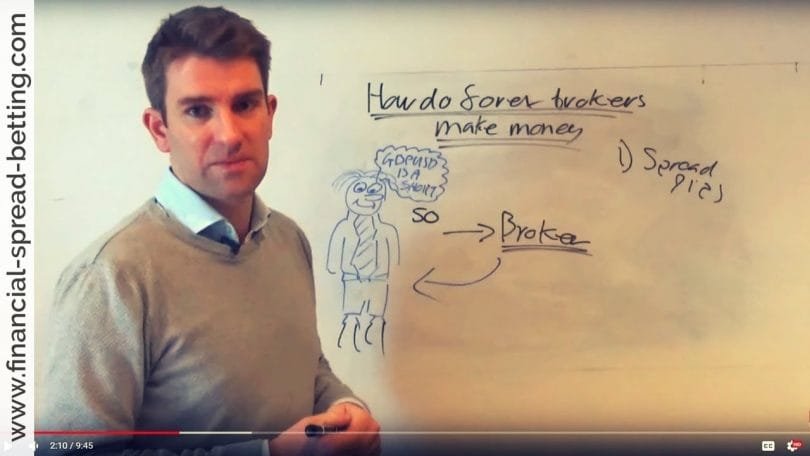

Q. How does a spread betting company make its money?
A: Spread betting providers make money in a variety of ways. Spread betting brokers make the most of their money from the spread; they typically add a small margin above the usual market spread, so a share priced at 100p to sell and 102p to buy might be 99p to sell and 103p to buy via a spread bet. For instance as I’m writing the spread around the underlying bid and offer of Vodafone is a total of 20 basis points (0.2 of 1 percent). The spread means that at any given time, the price that you can buy at is always higher than the price you can sell at. This also means that the provider makes a profit from the spread whether you win or lose.
Your spread bet does not affect the share price of vodafone as it is a contract between yourself and the spread betting provider. So, if you go long by 10 pounds a penny the provider is effectively short 10 pounds. Bear in mind that there may be thousands of trades in vodafone throughout the day so the provider’s overall position may be constantly changing. Ideally, for every trader placing a long position with a spread betting provider there is another trader placing a short bet. This means that one trader will win and one will lose, and the provider will end up simply making money from the spread. In practice, depending on the nature and overall size of the provider’s ‘book’ they may also hedge their exposure independently – which could take the form of buying or selling shares on an exchange. However, the fact is that if a spread betting firm doesn’t hedge your bet in the wider market, then they stand to win when you lose and lose when you win.
Also note that for a stock like vodafone there is plenty of liquidity but for others there may be very little so a provider may potentially offer a limited size in which to trade. Many illiquid stocks (in the open market) have a number of market makers that offer prices, but again, only in a certain size (normal market size – NMS). The normal rule of thumb would be that the provider is able to offer the equivalent as a spread bet so that that they can cover that bet fully (and not over-expose themselves).
And they also charge you financing on your open spread bets (currently about 5% a year) – this either takes the form of a daily financing charge or by adjusting the price of your bet. Of course they will also make money on the interest generated on unencumbered funds…and all these charges taken together do add up so it is imperative that you shop around for the best combination of spreads, margin and financing rates.
How do spread betting companies make money?
In practice they make most of their monies in four ways -:
1. Providers assume a degree of risk on a B book.
2. They agency broke big clients or A book clients and capture commissions.
3. They capture the spread from different clients trading on opposite sides of the price simultaneously.
4. They charge overnight funding to rollover positions.
The B book for most spread betting firms will be where they make most of their money. Spread betting firms take a look at the entire B book (not individual B book clients) and some human trader takes a view as to how much of the the net risk IG wants to take (the rest of the risk is laid off in the underlying market).
IG (in this case) will decide on what is a reasonable amount of risk to run from their client flow. The spread the client pays when he initiates the deal is enough of a disadvantage to make the spread betting company a slight favourite. This advantage of risk to the market maker is why they run B books. The spread betting company will not run risk against all of its clients, only the ones that haven’t been allocated ‘A’ book. EVERY other client is ‘B’ book and these are the clients that the spread betting company takes on. Too many B book clients trading in one direction will mean that the risk limits of the spread betting firms will be breached and a hedge or series of hedges in the underlying market will be executed and the risk returned to its accepted levels. This is the only time B book clients are hedged and it is done as little as possible. When the spreadbet company hedges in the market they are paying someone else’s spread and that can mount up to an expensive cost that is avoided unless absolutely necessary.
‘A’ Book clients. This is easy no risk business for spreadbet companies. An A book client is a client who always deals in big enough size that the B book risk limits are bust and a hedge will need to be done to reduce the B book risk, or he is a client who is good and is backed off so the risk is with the underlying market rather than the broker. Depending on your relationship with the spread betting company an A book client will be charged anywhere from a specially negotiated fee to a premium on the standard spread. Spreadbet firms do not retain any risk from A book clients.
Client X sells £10 a point EUR/USD at 1.2350 at the same time client Y buys £10 a EUR/USD at 1.2352. The spreadbet firm has no risk (the 2 clients have hedged eachother) but has locked in £20 profit from the spread. Happens more often than you’d imagine.
Overnight funding is a revenue stream. I don’t think any Spreadbet firm has ever denied this. Simply the underlying market will apply market funding to the total net position of the spread betting provider, whilst the spread betting company will widen the funding and apply it to EVERY client position rather than the net position.
How do spread betting firms make most of their money?
Where all spread betting companies hope to take money is by getting as many buyers as sellers, so we can make the spread with no risk. If not our dealers can go into the market and hopefully buy the shares at a better level. If they can’t, they cover our risk and take the loss. We don’t employ 17-year-olds to go into the market and do whatever they wish. We employ professional dealers to manage our risk. If we have a very good client who makes a lot of money we might ‘over hedge’ him. Say he’s bought 10,000 BP equivalent shares by making a £100 up bet, we might go in and buy 15,000 because we realise that he has done all the analysis and spent time on that particular product. We quote 1,800 products, we haven’t got time to look at them all individually. – Spread Betting Insider
Perhaps the right question to ask is: How do spread betting providers NOT make money?
The December 2009 trading update from London Capital Group provided some interesting insights into their business model. The shares of LCG took a battering after the group posted a profit warning. This is interesting.
Reading from the trading update, a number of interesting factors contributed to the profit warning that I think spreadbetters would find interesting:
1) Development of these white label partner sites is turning out to be costly.
2) Spread betters are winning more. Which of course is good news for us. This seems to imply that when the market is stable (i.e. relatively predictable), and with the markets in a general upward direction since March 2009 (to December 2009) it becomes easier for punters to come out on top. ‘Less volatility means that people are more confident about sitting on their positions when the market goes the other way,’ on analyst from the Financial Times was quoted as saying. Thus less people close out their losing positions, which is how spread betting providers make large portions of their monies.
For spread betting providers, the worst conditions appear to be slow-moving markets – as they encourage spread traders to hold a single spreadbet as opposed to jumping in and out with fresh bets. Low trading volume and having to split revenues with white-label partners can dent profits during calm markets. But volume and profits soar when volatility is high – as is the case at present…
How do spread betters make money? There is a conspiracy theory that companies only make money by clients losing money.
Let’s be honest, we’re in the business to make money. We’re not a charity but we facilitate the business. If we can make our little cut in facilitating the client into the market then we’re very happy to do it.
It’s not in our interests for clients to lose money because if they do they stop trading. Of course, we do like an opportunity to hedge their positions at an advantageous price but every bookie in the world lays off extra risk. We have clients who trade in far greater size in currencies than we could ever tolerate as a risk, so we go out and hedge. It makes my board very happy when our hedge book makes lots of money.
We quote very tight prices. If we have a client who trades everything in big size and it moves in his favour immediately, giving us no chance to get a hedge on, we’re going to struggle. But in normal circumstances if he’s a good trader then we’ll follow him and following him in a bigger size than he’s traded with us. – Spread Betting Insider
Q: When you take on a spread bet you’re taking a bet against the spread betting provider…Is that correct?
A: Technically, yes this is correct – when you take on a spread bet, you’re taking a bet against the spread betting company as it acts as the counterparty to your trades. Remember that spread betting is just another vehicle with which to trade the financial markets, but it’s a zero sum game: there’s always someone on the other side of your trade. Spread betting providers hedge your position internally by matching opposing trades or by taking real positions in the markets (I am pretty sure that I have heard them go long in the market a few times when placing bets on the telephone) but they still have an inherent interest in you losing on your bet. This is because market makers not only make money on the spread and through commissions and perhaps financing over time, but they may make more money if you lose on your trade if they don’t have an underlying hedge (and they won’t run a hedge for small exposures).
We know that with short-term trading no wealth is created, it’s just shifted around from you to them (or other traders). When using spread betting to open a position in any direction the ‘trader’ is theoretically betting against other ‘traders’, as the normal practice is that roughly as much short money as long money is going in so they make their money on the spread and the clients that are correct merely take the money off the clients that are wrong. However, for this setup to work the flow of business has to be so large as to make the market direction virtually academic to a provider’s revenue income. Should there be some rather large discrepancy between the two groups either due to either a few clients having very large positions or the majority of clients are going in the same direction, the ‘provider’ will have to hedge itself so it does not go ‘bankrupt’ or make a substantial loss should the group with the overweight position ‘win’.
Having said that, for spread betting providers to attract customers, it’s in their interest to represent the underlying market as close as possible, otherwise they will be worse off overall and also open themselves to arbitrage opportunities. Quite obviously I still prefer spread betting to CFDs (with a CFD DMA position like those offered on IG Markets you are technically taking a position against another trader) because of the whole tax free benefit but it’s important to note that they can’t actually mess you about too much since prices mirror real underlying markets and because you’ll just move on to another company as there is a lot of competition in this sector.
Slippage on CFD on Equity Index Instruments: Since the price on IG only seems to loosely correlate to the underlying market, how are stops in IG’s book elected. If you’re IG, looking to manage risk and have a full view of the stops in the book, IG could elect the stops to manage its own risk no? There seems to be some chatter about this. Equally if an underlying moves significantly through a limit and a customer is in profit but IG’s book is not, IG could manage its quoted prices so as not to trigger the limit?
Slippage and stops: Yes the spread betting company could place a stop just before or after the clients stop level (note, this is only A book clients as all other clients are part of the overall risk) but its a very risky move. for example, say the client put a stop to buy £1,000 point of EUR/USD on stop at 1.3320, the s/b firm to hedge this risk will place a stop to buy €16.8M (£1,000 point equivalent) of EUR/USD at 1.33195 (they’ll be happy making half a pip on £1000)… lets say the market goes to 1.3317 very quickly and the client decides to move his stop to 1.3350 but the s/b firm hasn’t noticed or reacted quickly enough to move their stop from 1.33195 to 1.33495 and the market spikes to from 1.3317 to 1.3325 and then spikes down to 1.3305…the spread betting firm is now long at 1.33195 (or maybe 1.3325 depending on what bank filled the order) in a market that is 1.3305 offered. This would be a running loss of £14,500 which is not something that can be allowed to happen too often. Therefore, with A book clients if an order is put in to the market against them the client is normally told and asked to let the dealing desk know if they move their stop. You may find this difficult to believe but it is correct. Relationships between most A book clients and most spread bet firms is excellent – they work together to make it easier for them both.
