
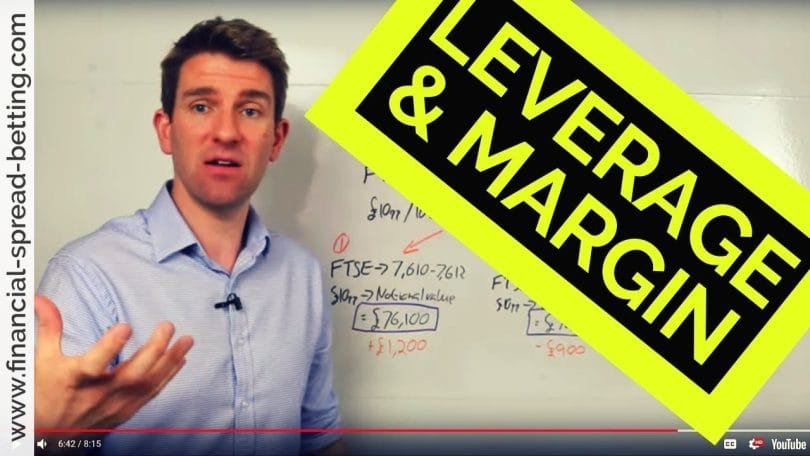

Q: What is Leverage?
Leverage is naturally all about risk and on markets like foreign exchange and indices it is quite simple to calculate when spreadbetting -:
Suppose you buy the FTSE at £5 a point at 4,500 with a stop loss order at 4,400, then your risk (assuming your stop kicks in at 4,400) is £500. Your total position is 5 x 4,500 = £22,500. Your initial margin requirement on this spread trade would be somewhere in the region of £500 to £1,000 depending on which broker you trade with and whether your stop loss level is taken into consideration.
More likely where people tend to get confused is when they trade stocks £x per point -:
They do, for instance £10 per point on Marks & Spencer when the share price is trading at 300p. The initial margin requirement may be for instance £300, but their total position size would amount to an exposure of £3000 to Marks & Spencer (£10 per point x 300p). So it is the same as if you had 1,000 shares.
A quick way to help you trade in the beginning is to use this rule -:
£1 per point is the equivalent of 100 shares
£10 per equiv 1,000 shares
£100 equiv 10,000 shares…etc
Sensible use of margin is not something to be afraid of. Abuse of margin in relation to the size of an individual’s account is what can get traders into trouble.
The spread betting leverage means that you can get rich which is a wonderfully appealing idea, but it also means you can get poor which most people ignore. A large risk to one trader may be an acceptable level for another.
Q: What is the difference between leverage and margin?
A: In financial terms, leverage is about re-investing debt in an aim to earn a bigger return than the cost of the interest (financing). When an investor uses big amounts of debt to finance his investments, he is considered to be highly leveraged. In such circumstances, both gains and losses can be equally amplified.
Margin is a form of ‘borrowed money’ that is utilised to invest or trade in other financial instruments. Often, it is used as collateral to the holder of a spreadbet or CFD position in shares or future contracts to cover the credit risk represented by the investor when they have a position in a share or futures contract. The margin account is utilised to absorb any losses that may follow from fluctuations in market prices. Margin also helps to decrease the risk of default since because it is constantly being monitored by the spread betting provider to ensure that the investor is able to honor the contract. This can be a practical way of acquiring funds in order to invest in a profitable investment.
The concept of leverage and margin are in practice interconnected since you can use a margin to create leverage. Leverage empowers traders to trade assets and generate higher returns that would be possible in the absence of it. Unfortunately, a leveraged investment also brings about more risk because if the speculative investment does not result in the expect returns, you still have to pay back the debt plus interest. A margin account empowers you to borrow money from a spread betting or CFD provider for a fixed interest rate (financing) to open contracts in the anticipation of receiving substantially high returns from your stock market predictions. It is crucial when considering this form of investment (i.e. margin trading) that you do a thorough investigation to make sure that the market you are thinking to trade is liquid and not too risky.
When you are trading in shares through a spread betting provider you are in effect speculating on margin. A part of the spread you are paying is due to borrowing costs. Margin in general starts at 5% on UK blue-chip (FTSE 100) shares while most other FTSE constituents can be traded with 10% margin. In practice, what this means is that you can buy £50,000 of UK stocks while only putting down between £2500 and £5000.
So, that’s the risk but what about the reward? As mentioned before, there is the potential for big gains with spread betting, particularly because the bets are ‘leveraged,’ meaning that bettors are required to put down only a percentage of the total value of the bet they are making, the balance being made up of credit advanced by the spread betting company. For example, if you want exposure to Tesco you could buy 10,000 shares, but it would cost you in the region of £17,000 [with Tesco shares trading at £1.70]. Alternatively, you could place a trade with a spread bet, for which you would need to deposit only 4 per cent of the value of the trade, £680 in this example.
The obvious advantage of leverage is then that it’s possible to buy and sell assets for many times more monies than the amount deposited. To help understand this, let’s use an extreme example. For instance if I deposited £500 to my account and wanted to buy into oil, with leverage of 1:100 I could buy oil for £50,000! Then even a very small increase in the price of oil by 1% would earn me £500… Without financial leverage, a 1% increase in the price of oil would have only net me £5 from the £500 deposited. Of course this can also work in reverse and a 1% drop in the oil price would then have wiped out my £500 deposit.
Q: But isn’t utilising leverage to trade more risky than shares trading?
A: Spread bets are not necessarily more risky: there are no dangerous spread bets, only dangerous spread bettors. Those that claim spread betting is risky don’t understand the subject matter. In fact spread betting is no different to buying shares if you do it sensibly and are not leveraged to the hilt. It is just cheaper as you do not pay stamp and brokerage (they make their money on the spread, hence the name).
Used in the correct way, spread betting is simply another way to reach the same goal of backing an asset that moves the right way – just think of spread betting as a useful trading tool to help our overall wealth-life balance with some important advantages over traditional shares dealing.
Let’s take an example and assume you have a 100k pot. Willing to risk 1.25% on one particular stock => £1,250
There is a stock XXX which trades @ 25 pence, with an all time low @ 10 pence. It looks like a good quality stock with a good business plan for the long term -:
1st case scenario: Normal share dealing
Stop loss at 9p
Purchase 7812 shares
if the share price goes to 9p, you lost £1,249.92
if the share price goes to 50p, you made a profit of £1,953.00
if the share price goes to 150p, you made a profit of £9,765.00
2nd case scenario: Spread betting
Stop loss at 9p
You bet GBP 78 per point
if the share price goes to 9p, you lost £1,248.00
if the share price goes to 50p, you made a profit of £1,950.00
if the share price goes to 150p, you made a profit of £9,750.00
This demonstrates that as long as you risk the same amount, the reward whether spread betting or through traditional shares dealing is the same.
…but…
However, do keep in mind that you have the overnight carry charge, or wider spread if buying quarterly contacts, which adds to the cost. The spread is wider (but does not fluctuate more than the open market because it is based on the open market…or so they say). And of course gains from spread betting are tax-free while those from shares dealing are not! And it’s why I don’t understand why people go on about spread betting being so difficult or different. It’s not.
Sure, spread betting is leveraged (i.e. geared) meaning your gains or losses are amplified – with most spread bets you only have to pay 10% of your total market position meaning that percentage return could be up 10 times as high! This is where most spread bettors fail – they do not understand leverage; well that and greed!
Think about trading with £3000, would you be comfortable risking this amount or would you lose sleep at night? If you’d lose sleep at night then there is too much emotion attached to that amount. Try using a smaller amount, for example £500. Would you be comfortable trading with £500? If this is better then this is your comfort level. Trade with this amount until you are happier to trade with more.
Of course with shares your losses are limited to your initial investment but this limits gains too! Leveraged trading suits a more aggressive trader who is prepared to take a bigger degree of risk and accept greater volatility for potentially bigger gains. The biggest trap is overgearing. Unless you have a stop loss in place, your losses could be potentially unlimited. This is why stop losses are so important in margined trades as they allow you to set the maximum amount you are prepared to risk in the event that the market moves against you. By using stop losses you still get the benefit of unlimited profits, but at the same time you set your maximum loss, which is usually only a small percentage of your overall investment bank.
Even so if you are somewhat concerned about the possibility of losing more than the amount invested you could always open a limited risk account which some providers offer. With this, every trade you open has an con-jointed guaranteed stop loss order built into it, which provides complete peace of mind that you will never lose more than the deposited capital (although this comes with slightly wider spreads).
The only tangible restriction I see is effectively time. If you have a 6 months plus time horizon, then physical share holdings become a more prudent way of holding the shares. Other than that, the restrictions are all intangible and in the mind of the account holder and in his personality.
Spread betting gives far greater flexibilty and one could argue lower risk than physical (but that’s only in my opinion):
-> You control your margin, you don’t have to leverage up.
-> You have the widest range of possible markets at your fingertips.
-> You have the best technology.
-> You have the swiftest execution.
-> You have fractions of a share or future to trade in.
-> You can even insure your risk at the outset using guaranteed stop loss orders.
-> You can go long or short.
-> You pay less commission on smaller trades.
-> You pay no Stamp Duty.
To be honest, spread betting is what you personally make of it. If you want to use spread betting for reckless gambling then it is there for you, if you wish to use if for hedging purposes, such as short selling a house price index then it is there for you, if you wish to use it for short to medium term speculative returns then it is there for you…
To conclude gearing suits a more aggressive investor who is prepared to take a greater degree of risk and accept greater volatility. And remember; Stupid is what stupid does.
Dealing on margin can significantly magnify your profits, but can also significantly increase your losses; that is why spread betting is often said to be riskier than buying shares through your stockbroker. However, at the end of the day you control the amount of margin you utilise; and it is not very wise to be fully geared.
Q. Why use gearing? What’s wrong with getting rich slowly?
Sooner or later I am going to hit trouble. And if I am leveraged, that means the trouble will be more severe (perhaps fatal). If I’m not geared (and reasonably diversified – “may your God of Diversification go with you”), it may still be a heavy blow but it can’t be fatal.
The only reasons I can see for gearing up is if you are:
(1) in a desperate haste to become rich;
(2) believe it’s pure luck and want to take catch a winning streak…
Am I missing something?
A: Yes, I think some people’s use of gearing is largely emotional – you know to make it more exciting! Geared products are where investing meets gambling, and there’s not really a clear cut-off between the two, just shades of grey. Some spread betters will argue there’s little point in using no gearing if you are moderately comfortable in your decisions. Risk-averse investors will avoid gearing like the plague. Leverage is really as dangerous as you make it and getting stung a few times has helped me learn to respect it!
There are also those who have relatively little capital but which they can probably also afford to risk. For them using leverage is a way to produce significant returns, in cash terms, and grow the capital more quickly especially when opportunities abound. I can see the logic in using gearing in that situation, provided the increased risk of loss is acceptable, such as when you are relatively young, with some job security and not too bogged down with financial commitments. It is really about trying to estimate the worst scenario in a potential downside; you may say this amounts to 100% of the money you have put down and be spot on but I would argue that if you pick a company with a decent asset base and low gearing you would be hard pushed to expect a total loss. Needless to you with geared instruments like spread betting it is sound policy to always use a stop loss to prevent you from going below zero or you might end up owing your spread betting provider a few grand.
However, I would say there’s certainly times that one wants to load up on risk either by portfolio concentration or moderate gearing but doing both periodically is unnecessary and can be difficult to manage – as well as being psychologically draining as heavy gains will also be mixed with some heavy losses.
Whichever way you put it, one’s trading strategy should suit one’s personality, age and position in life (whether you have dependents or not…etc)
Q. Sometimes it appears to be more efficient to spread bet and sometimes more efficient to purchase a share (or other instrument)?
I have a general question on spreads: (only looking at longs rather than shorts here). It appears to me that it may often be a close call whether or not to use a spread bet instead of a purchase often depending on the trade size; and there is a crossover between the two where the smaller spreads of share (say) which you purchase + the stamp duty, plus broker fees ends up being more expensive than doing an equivalent spread bet even after accounting for the spread betting companies wider spreads.
So sometimes it appears to be more efficient to spread bet and sometimes more efficient to purchase a share (or other instrument). Is this correct, or am I missing something?
A: That’s right regarding spread betting; sometimes it’s cheaper to buy the stock but then if you don’t have the capital to do so then spreadbetting is a good option.
In any case the problem is not the leverage but how traders/investors use it. You need to balance the amount of leverage on your account so as to maximise the opportunities for profit while minimising losses in unfavourable market conditions. Take for instance the case of a share trader who made 15% over the last year. By utilising 2 X leverage for the upcoming 12 months, the return could be potentially increased to 30%. This is a very good return. The problem is that traders/investors get carried away – they sometimes even utilise 10 times the leverage which dramatically increases the risk for much bigger losses (as well as gains).
