


The Group expects to report revenue of approximately £298m (2009: £257.1m) and adjusted profit before tax of around £157m (2009: £125.9m), representing approximately 16% revenue growth (13% on a constant currency basis) and 25% profit growth. Adjusted profit before tax is stated after exceptional costs of approximately £5m relating to the decision to relocate the Group's London office later this year. On a like for like basis, excluding the impact of FX Online Japan, which was acquired part way through the prior year, revenue growth was 20%.
The Group has benefited from an increase in volatility in both forex and equity markets in the last few weeks of the year. This volatility boosted client activity and hence revenue and also increased the rate of new account opening. As a result the final quarter, despite starting with low levels of volatility, showed strong revenue growth, up 24% on the corresponding period of the previous year. Account opening in the final quarter was strong, with 21,500 financial accounts opened, compared to 18,750 in the final quarter of the preceding year. The UK, Europe, Japan and Australia all contributed to this increase in account opening.
 |
|
 |
|
The Group achieved net recoveries of doubtful debts of £1m during the period.
The Group's UK financial business continues to deliver solid growth, achieving revenue of £162m, compared to £150.6m in the prior year, an increase of 8%. Revenue growth in the final quarter was strong at 17%. This growth reflects the continuing growth in the Group's UK client-base.
The Group's Australian office delivered exceptionally strong growth, achieving revenue of £46m, compared to £27.9m in the prior period, an increase of 65% (43% on a constant currency basis).
The Group's Singapore office achieved revenue of £11m, up from £9.5m in the previous year, an increase of 16%.
The Group's European offices also delivered strong growth, achieving revenue of £47m, up from £30.2m, an increase of 56% (54% on a constant currency basis). All of the Group's European offices contributed to this growth, but growth was strongest in Germany, particularly in the final quarter of the year.
Revenue from the Group's Japanese office was £24m, compared to £27.9m for the 8 months of the prior year during which the business was owned by IG. The Group's revenue from Japan has shown sequential improvement in each of last four months and revenue in the final quarter, of £8m, was 40% higher than that achieved in the best of the previous three quarters. As previously announced, the first of a number of regulatory restrictions on leverage comes into force in Japan on 1 August 2010.
During the period the Group's US-based exchange, Nadex, received the necessary change of regulatory designation to enable it to accept clients via intermediary brokers. The Group is in discussions with a number of brokers with a view to their offering direct access to Nadex to their clients. The work needed to connect certain third party trading platforms to Nadex is at an early stage. It is therefore likely to be some months before these arrangements come to fruition. The Group's US businesses achieved revenue of £2m in the period (2009: £2.3m.
During the period the Group made a number of changes to its Sports business, which have stabilised its profitability and reduced the volatility of its revenue. The business achieved revenue of £6m during the period (2009: £8.7m).
It remains difficult to predict future trends in volatility or customer reaction to changing market and economic conditions. Strong account opening and the continued development of the Group's offering leave the Group well positioned for further growth.
Derivatives provider IG Group expects to report pre-tax profit up by almost a third at the half-year period boosted by new market growth offsetting flat sales at its core domestic units. The Group reported strong first-half profit with pre-tax profits for the first six month of the years amounting to £77 million, 32% ahead of last year and quite ahead of the £66 million projected for by analysts as the Group's emerging markets made strong contributions to earnings.
The Group, best known for its IG Index spread betting flagship site allows retail traders to bet on price movements in stocks, currencies and commodities - stated it will continue to invest in its businesses, infrastructure and products to grow further.
In a trading update, IG Group said pretax profit for the six months ended November 30 is expected to be about £77 million, up from £58.2 million in the corresponding period a year ago.
Despite tougher comparisons with a trading boost following the collapse of Lehman Brothers, the Group grew overall revenues to £143 million from £129 million, excluding a major Japanese acquisition in October 2008.
The expected revenue is higher than the £136 million average expected by three analysts.
'The group has achieved growth in the first half against a challenging economic backdrop and strong comparatives from the first half of the prior year,' the company said.
'Activity and account opening levels remain strong and the group continues to invest in its businesses, infrastructure and product offering,' it said.
Its operations in the United Kingdom, which still contributes the majority of earnings, had first-half revenue of £80 million, similar to that in the same period last year. This was however offset by the newer offices established in Europe and Singapore, as well as the more mature Australian operations - all of which saw strong revenue growth.
The European offices achieved revenue of £22 million, up 65% from £13.3 million. Singapore's revenue grew 22% to £5 million. In Australia, revenue grew 64% to £22 million.
Revenue from the United States operations was up a marginal 2% at £1 million. Revenues in IG's FXOnline Japanese unit however fell in the second quarter to 5 million pounds from 6 million in the first quarter. That compared with 10 million pounds in just 2 months of the comparative period last year, after strong competition hit the group's performance in spring and summer. IG, however stated that there were encouraging signs at its Japanese currency business FXOnline. IG Group bought out FXOnline to increase its geographical footprint in Japan but has faced tough competition and changed its pricing in October to win back clients. In October 2009, FXOnline moved to a lower risk, low fixed spread model, and offering a more balanced portfolio between Forex and the newer contracts for difference (CFD) and binary option products. IG hopes to benefit in Japan from its leading position in contracts for difference (CFDs).
The company also stated that it had managed to clamp down on bad debts accumulated in last year's financial crisis and the bad debts write-off for the 6 months to 30 November was less than 0.5% of revenues compared with 12% a year earlier when the stock market turbulence caught many punters by surprise.
Excluding Japan, IG Group opened 32,000 accounts globally in the first half, approximately the same number as in that period the year before. IG anticipates that it will experience higher costs in the second part of the year as it recruits more staff to cope with the higher than expected activity. The Group also expects to incur a 4 million pound charge for new headquarters in London.
Steve Clutton, finance director, claimed that customers had been lured to IG over competitors because of a superior platform. 'They might be attracted to a headline 'low price' - but they quickly realise that price isn't everything.'
This update demonstrates that IG's growth story is not over and that double-digit growth remains likely as the client base matures and IG Group continues to win share against competition.
IG's shares crashed earlier this year as a result of bad debts and amid fears of slowing growth the UK but the write-off for doubtful debts in the first 6 months was lower than 0.5% of revenue, compared with 12% in the first half of last year. Virtually all IG's markets are still showing quarter-on-quarter revenue growth and the group has even gained market share in the United Kingdom and Australia; which constitute IG's most competitive markets. IG has offices in 11 countries, many at relatively still early stages of development and while it is not simple to predict how these newer markets will perform, this update confirmed that there is scope for additional growth potential albeit with some execution risk. Revenues from the Group's FX Online division in Japan have however been somewhat disappointing and the company is still awaiting confirmation of restrictions on leverage from regulators.
IG Group Holdings plc (LSE:IGG) released an Interim Management Statement this morning in reference to their performance in the first quarter of the current financial year.
Group revenue for the quarter was approximately £68m compared to £53m in the corresponding quarter in the prior year, an increase of approximately 28%. Excluding the impact of FXOnline Japan KK ("FXOnline"), organic revenue growth was 17%.
The charge for doubtful debts in the period was less than 1% of revenue. Other operating costs were in line with management expectations.
Financial revenue from clients dealing with the Group's London office increased by 4% to just over £39m. Australian revenue was up by over 50% to £10m.
The Group's six newer offices in mainland Europe, Singapore and the US increased revenue by around 80% to over £11m. Germany and France in particular delivered strong growth.
FXOnline achieved revenue of £6m in the period. It continues to experience a challenging competitive environment for forex and is developing its offering to ensure that it is competitively positioned. It is making good progress on increasing its revenue from CFDs and binary options, which are relatively new products in Japan and where the competitive environment is more favourable.
The Group's US exchange, Nadex, has applied to its regulator, the CFTC, for the necessary changes in designation to enable certain regulated intermediaries to trade and clear customer orders on Nadex. Until this change of designation is approved the Group is undertaking only limited marketing in the US.
The Group's office in Stockholm opened for business on 31 August 2009 and the Group continues to evaluate other potential new markets for future development while making good progress in developing its introduced and white label businesses.
Account opening, a key lead indicator of future growth, remains strong. During the period the Group opened over 21,000 financial accounts, an increase of 72% on the number opened in the corresponding period of the prior year. Excluding FXOnline, the like-for-like increase was 23%, driven principally by increases in the rate of account opening in the UK and Australia.
The new financial year has started well, despite subdued forex and equity market volatility. The normal seasonality impact in the northern hemisphere was somewhat offset by clients' increased trading activity in shares during the strong rally in equity markets over the final seven weeks of the period.
As previously noted, the Group faces more challenging comparatives in the second quarter, as both revenue and account opening last year were boosted by the volatility caused by the extraordinary market events of September and October.
It remains difficult to predict future trends in volatility or customer reaction to changing market and economic conditions. Strong account opening and the continued development of the Group's offering leave the Group well positioned for further growth.
IG Group PLC (IGG.LN) Tuesday gave an upbeat outlook for its fiscal year started June 1 despite lower market volatility, saying new account openings have continued apace and that it has gotten a handle on bad debts.
"The new financial year has started well, despite subdued market volatility. Our longer-term growth trajectory continues to be underpinned by good levels of account opening and I remain confident about the prospects for the coming year," Chief Executive Tim Howkins said.
An improved fourth quarter, more customers and fewer doubtful debts at IG Group have helped lay to rest immediate fears for growth in the spread betting industry. The update contrasted the profit warning last November (2008), when last autumn's financial turmoil left it with £14.7 million of bad debts from client losses. And, more recently, in March, when quarterly revenues in its core UK business unexpectedly dropped 7 per cent - raising fears that the stellar growth that the company had enjoyed since returning to the stock market four years ago was coming to an end.
IG opened over 74,000 accounts during the financial year to the end of May, up from 43,000 a year earlier, helping it post a pre-tax profit of £125.9 million, up from £97 million a year earlier and compared to the company's earlier guidance of £125 million.
The company is to pay a final dividend of 11 pence, making the full-year dividend 15 pence, up from last year's 12 pence.
The outlook came as IG Group reported its results for the year ended May 31. It made £125.9 million in adjusted pretax profit, up 30% from £97 million in fiscal 2008, and £257.1 million in revenue, a 40% increase from £184 million. The numbers were inline with analyst expectations and guidance given by the company last month.
The pretax profit number excludes amortization and impairment of intangibles related to IG Group's purchase of FXOnline in October. The company made a net loss of £8.5 million after amortization and impairment, compared with a net profit of £78 million in fiscal 2008.
Justin Bates, analyst at Daniel Stewart, kept a hold rating on the stock, saying it is a solid set of numbers but that it will be hard for the company to match the 2009 fiscal year's strong first half, because of lower volatility.
IG Group said U.K. clients continued to be the main contributor to the bottom line, producing £150.6 million in revenue, compared with £137.5 million in fiscal 2008.
But it indicated it is counting on its newer offices, in locations that include Singapore, Italy and the U.S., to become big drivers of future growth as revenues from its increasingly mature UK operations start to slow down rising just 9 per cent on the year - pointedly the first time they have failed to break into double digits. About 15 percent of the group's revenues were generated from Europe, according to client location, as it opened operations in France, Spain, Italy and Germany in the past two years. Between December 2008 and May 2009, European revenues rose to £21 million from £11 million in the same period a year earlier.
"A lot of growth in the coming year will come from the continued acquisition of clients in some of the newer markets, places like France and Spain that should eventually get to be the same size as the U.K. market," Howkins told Dow Jones Newswires.
Indices accounted for 38 percent of the total revenues, currencies 35 percent, shares 18 percent and commodities and sports for the rest. No longer is this a hobby of rich city boys, as more and more armchair traders get involved. The firm is attracting a variety of players as interest in trading stretches beyond the city. Less than 2% of our customer base are City types and though you think that might have changed by the number of people being made redundant but wanting to remain in the market, we have only seen a marginal effect.
However, its Japanese FXOnline business, which it paid £117.6 million for, "faces challenges," IG Group said. The unit made £28 million in revenue between its purchase and the end of the fiscal year, less than had been anticipated at the time of its purchase because of a drop-off in revenue earlier this year from fiercer competition - mostly from small domestic players who have spent heavily on television advertising and cashback schemes - mean the short-term profitability of its niche has failed to live up to initial expectations.
Howkins said the company started using variable bid-offer spreads from June 1 to help attract more trading, with some success, and in the past few weeks has introduced lower fixed spreads to win back large clients who had found them offered elsewhere.
Howkins told Dow Jones it doesn't want to join a "bottom fishing war" that some of its competitors seem to be engaged in, with spread offers of as little as a tiny fraction of a cent, and instead is repositioning FXOnline as a premium provider for experienced traders with more money to put to work.
A potentially bigger threat is from the Japanese financial markets regulator, which is looking to limit the amount customers can borrow on their capital for retail forex trading, a move that could hit FXOnline revenue.
The proposals aim to eventually cut leverage to around 25:1, while FXOnline's Web site says customers can gain as much as 700:1 borrowed money to capital.
The final plan, which is expected to be announced within a few weeks, wouldn't be fully implemented for two years, though, giving IG Group "considerable time to prepare."
Doubtful debts from customers - those the company is pursuing for repayment - fell to £3.5 million in the second half. Before IG Group put in place more-stringent rules on extending credit to customers, first-half doubtful debts were £14.7 million. The total for the year, £18.2 million, represented about 7% of revenue.
In fiscal 2008, IG Group impairments from bad debt were about 2.2% of revenue, at £4 million.
Meanwhile, the company said it will start deferring part of U.K. employee bonuses to comply with new guidelines from the U.K. Financial Services Authority.
Edited Press Release
January 20 2009,
IG reported net income of £37.7m ($52.5m) for the six months to November 30, up from £33m a year ago. Revenues - 39 per cent of which came from outside Britain - rose by 47 per cent to £126.5m. Pre-tax profit rose to £54.6m on a statutory basis and the interim dividend was raised by 33 per cent to 4p. At the present time IG has over 33,000 spread betting accounts, and 25,000 CFDs ones with a further 100 new UK clients signing up every day.
The Chief Executive, Tim Howkins, said revenue in the six months to November 30, 2008, was £126.5 million, an increase of 47% over the same period last year. Organic revenue growth, excluding the impact of acquiring FXOnline Japan KK, was 41%. Adjusted profit before tax was £58.2 million, up 21%.
This growth was achieved against a backdrop of steadily worsening capital market and economic conditions worldwide and reflects the resilient nature of both the company's business model and its client base. Different aspects of the business are better suited to differing market conditions.
During the equity bull market revenue from clients trading in individual sares grew very strongly. Since global equities began to decline in 2007 IG's shares business has been weaker, but these market conditions lend themselves very well to short term trading on indices and currencies.
Revenue from both these areas has grown very strongly, more than making up for the weakness in sares and, together with the impressive performance of the company's newer international operations, has enabled it to achieve continued strong organic growth.
Over the last three years IG has made considerable progress in its strategy of continuing to develop its U.K. business while also expanding geographically. The acquisition of FXOnline in the period was an important step in the development of the business and significantly strengthens IG's presence in the Asia Pacific region.
As previously reported, the company incurred significant debts in the extraordinary market conditions of October. It has taken a prudent approach to providing for these debts and consequently it's doubtful debt charge for the six months was £14.7 million, the majority of which arose in October.
The company is at a relatively early stage in pursuing these debts; historically it has ultimately achieved good levels of recovery of amounts initially provided and it expects this pattern to be repeated.
As a result of this recent experience, IG has changed its approach to managing credit risk, moving to a position where the vast majority of clients on margin call are closed out before they can get into deficit. Since it began the progressive implementation of this process fewer debts have arisen than in the past.
IG completed the acquisition of FXOnline at the beginning of October. In its first two months under IG's ownership it generated over £10 million of revenue and opened approximately 4,700 accounts. These achievements were partly due to the extremely high volatility of the Yen in October. The company is well advanced in our plans for the Japanese launch of its PureDeal trading platform and CFDs, both of which are scheduled for next month.
Since April 2006 the company has established offices in six countries worldwide: Singapore, Germany, Spain, France, Italy and the U.S. These offices are all delivering very strong growth. Together they accounted for revenue of £18.3 million in the period, compared to £2.7 million in the corresponding period last year, an increase of almost 600%.
The more established businesses grew revenue at somewhat diverse rates. U.K. spread betting, which contributed 46% of group revenue in the period, was the strongest at 34% growth, reflecting the very significant market leadersip we enjoy and the continuing benefit of high levels of client recruitment.
The much smaller U.K. CFD business grew at 7%, reflecting the fact that this is a business that has historically comprised mainly clients dealing in individual sares and the decline of trading in that asset class has slowed overall growth.
The Australian business grew at 21%. This is a business which built its client base through the equity bull market and the slowdown in growth when compared to the U.K. perhaps reflects a client base which is less accustomed to changing market conditions.
Independent research indicates that the company has gained market sare in Australia over the last year.
As a result of its strategy of international diversification, clients from outside the U.K. contributed 39% of our financial revenues in the period as a whole (int eh first-half of 2008: 27%) and 50% by the end of the period.
Account opening, which IG considers this to be the key lead indicator for its business has been strong across all of its financial businesses.
In the six months to November 30, 2008, the company opened over 36,000 financial accounts, compared to just over 19,000 in the corresponding period last year.
In the sport business the high growth that the financial business continues to achieve means that Sport accounted for only 3% of revenue. The company plans a re-launch of its Sports websites in the second half of this financial year.
IG's main focus in the second half will be on continuing to grow its existing businesses worldwide. However, it continues to evaluate a number of new markets.
IG also continue to develop new products and new platforms and it plans to launch a number of initiatives over the coming weeks. The first of these will be the launch of a new Direct Market Access platform, PureDMA, based on our award-winning PureDeal platform. It will launch this in Australia, where demand for DMA is most prevalent, next week, with a roll out in other countries to follow.
IG is also having an increasing number of discussions with online stockbrokers about white label arrangements, where the company offers its platform on their websites giving it immediate access to a large pool of potential clients.
IG has reached agreement with white label partners in both Europe and Asia Pacific and there are a number of other potential deals which appear close to agreement. I do not expect these new arrangements to generate material revenue in the current financial year, but they are likely to become increasingly important to IG in future years.
An interim dividend of 4 pence per sare amounting to £14.8 million will be paid in March. This represents an increase of 33% from the 3 pence interim dividend distributed in the six months to November 30, 2007.
British spread betting firm IG Group said it is on course for a 21 percent rise in half-year profit, buoyed by a surge in revenues as volatile stock markets encouraged clients to place more bets.
IG expects pre-tax profits of about 58 million pounds ($87.39 million) in the six months to Nov. 30, up from 48 million pounds in the same period last year, the company said in a statement on Thursday.
IG said it expects revenue for the period to climb 45 percent to 125 million pounds, partly reflecting a jump in betting volumes as its customers sought to profit from sharp share price fluctuations following the UK government's bailout of the banking sector in October.
"Global markets have seen exceptional events in this period and market volatility, particularly during October, was extraordinary," said IG Chief Executive Tim Howkins.
However, IG said the extreme market volatility had resulted in bad debts of 15 million pounds as some customers' bets went wrong. About 80 percent of the bad debts were generated in October, the group added.
IG Group Holdings said Thursday that for the six-month period ending Nov. 30 it expects to report revenue of £125 million (1H, 2008: £86 million) and pre-tax profits of £58 million (1H, 2008: £48 million), representing increases of 45% and 21% respectively.
Trading conditions have been strong in the period, particularly in the second quarter, and the Group has continued to achieve high levels of growth.
Both the Group's U.K. spread betting operation and the Group's CFD operation, which deals with clients worldwide, have contributed to this growth.
During October 2008 financial markets were extraordinarily volatile. The VIX volatility index peaked at 80, more than double the highest level it had previously achieved.
These market conditions resulted in extraordinary trading conditions for the Group, which achieved significant new records in October for monthly revenue, number of transactions and number of accounts opened. However, while the volatility produced significant additional revenue, it also produced significant uplifts in betting duty and doubtful debts, both of which were adversely affected by the impact of market volatility on clients' trading performance. As a result the Group expects that betting duty and the charge for doubtful debts will be approximately £7 million and £15 million, respectively for the six month period, with one third of the betting duty and almost 80% of the doubtful debt charge arising during October.
The majority of the doubtful debts arising in October relates to a small proportion of the client base (by number and revenue), and the larger debts arose primarily from client positions in RBS and the main equity indices.The incidence of doubtful debts, excluding October, has been broadly in line with that experienced in prior periods at around 2% of revenues.
The Group takes a prudent approach to provisioning and where the Group has previously provided for large individual debts, it has typically seen good levels of recovery over a period of several years.
The Group has taken a number of steps to reduce the risk of doubtful debts in similarly extraordinary market conditions in the future and will continue to pursue all outstanding debts vigorously.
The Group continues to achieve strong levels of account opening.
In the second quarter of the financial year it anticipates opening over 22,000 financial accounts, including around 4,000 at FX Online Japan in the two months since acquisition at the beginning of October. In the same quarter of the previous financial year the Group opened fewer than 10,000 financial accounts.
All areas of the Group's financial business have contributed to the strong growth in revenues achieved.
The Group's newer businesses in mainland Europe, Singapore and the USA continue to deliver very strong growth, with revenues in the second quarter expected to be approximately 85% ahead of those achieved in the first quarter.
Together these businesses are expected to contribute over 14% of the Group's revenue during the period, up from 3% in the corresponding period last year.
To date, growth in these businesses has come primarily from direct retail clients. As the product has become more established, the Group is seeing increasing interest from potential introducers and has reached agreement with large online stockbrokers in France and Spain to provide CFDs to their clients on a white-label basis. Discussions are on-going with a number of other potential white-label partners.
During the period the Group has opened an office in Milan, to supplement its existing Italian desk in London and has subsequently seen an increase in the rate of recruitment of Italian clients. The Group has also commenced offering CFDs to Portuguese clients from its Iberian office in Madrid.
The Group's internet trading platform has been resilient under extreme load conditions, placing the Group at a significant competitive advantage.
Over the last 12 weeks the Group achieved 99.98% reliability on its measure of core uptime.
At the beginning of October the Group completed the acquisition of 87.5% of FX Online Japan KK. Early performance has been strong with good revenues and material synergies being generated from the Group's more efficient hedging model.
Integration of the business is proceeding well and the launch of CFDs by FX Online is expected early in 2009.
Account opening and client activity remain strong across the Group and IG is benefiting from its broader international reach and increased product diversity.
The Group continues to evaluate a number of additional overseas markets.
The business remains debt free and highly cash generative.
Setting aside the exceptional charge for doubtful debts, the business continues to perform extremely well and the Board remains confident in the future prospects of the Group.
Britain's biggest spread-betting firm IG Group has met forecasts with a 40% rise in full-year profits as increased financial market volatility encouraged clients to place more bets.
IG said pre-tax profit for the year to May 31 was almost £97m, up from £69m the previous year.
IG said higher business volumes after the credit crunch developed helped lift revenue for the year by 51% to £184m. Spread bets allow investors to profit from falling as well as rising prices.
Revenue in the year to end-May rose 51% to £194m from £122m a year earlier, representing a quickening in the revenue growth rate, which over the last ten years has run at a compound annual rate of more than 40%.
UK-based revenues grew 46% to £123.2m, while mainland Europe saw growth of 73% to £20.4m.
Asia Pacific delivered growth of 115% to £27.4m.
Pre-tax profits rose 41% to £97m from £68.9m, but the EBITDA margin eased to 53.5% from 57.7% the previous year.
The company's spread betting and CFD businesses attracted 41,000 new account holders during the period, up from 22,500 the year before.
The sport betting arm saw revenue slide 5.5% to £11.5m, with the previous year's revenues having benefited from the FIFA World Cup in 2006.
IG Group Plc, which takes wagers on financial markets under the IG Index name, said full-year sales rose more than 50 percent after share-price turbulence prompted more gamblers to open accounts.
Sales climbed to about 184 million pounds ($360 million) in the year through May from 122 million pounds in the prior period, the London-based company said today in a statement. IG fell 2.6 percent, the most in two months, in London trading after saying higher costs will crimp profitability.
Sharper price movements in equity markets tend to spur bets, according to IG, which was started in 1974 so speculators could wager on the price of gold. The Standard & Poor's 500 Index has climbed or dropped at least 1 percent in 42 sessions so far in 2008. U.K. gamblers opened more than 2,000 accounts in each of the last five months to place so-called spread bets.
'Account openings have remained extremely strong,' Gurjit Kambo, an analyst at Numis Securities in London, said in a research report. IG probably will meet the securities firm's estimate of 20 pence in per-share profit for the year, and Numis may raise its earnings prediction for the current financial year by between 5 percent and 10 percent, he said.
Costs have advanced because of expansion, said IG, which opened French, Spanish and U.S. units during the year. An increase in betting duty to about 6 percent of sales from 3 percent a year earlier also will hurt the margin for earnings before interest, taxes, depreciation and goodwill, which will shrink by 4.7 percentage points to 53 percent, the company said.
IG dropped 10 pence to 380 pence, posting the biggest percentage slide since April 3. The stock's decline extended this year's drop to 6.2 percent and cut the company's market value to 1.24 billion pounds ($2.4 billion).
The Chicago Board Options Exchange Volatility Index, a benchmark for the cost of protecting against declines by the S&P 500, has climbed as high as 37.57 this year after closing 2007 at 22.50.
A gambler who places a spread bet pays or receives money for every point by which a stock or commodity's price, an exchange rate or an interest rate deviates from a specified range. Wagers also can be made on options and share indexes.
IG first became publicly traded in 2000, was taken private in 2003 by buyout firm CVC Capital Partners Ltd. and managers, and returned to the stock market in 2005. The company is scheduled to release its annual figures on July 21.
IG Group, which is the largest UK provider of financial derivatives such as spread betting, is a company very much on a roll. Founded in 1974 by leading Conservative party donor Stuart Wheeler, IG Index originally provided clients with the opportunity to by-pass strict exchange controls and place bets on the price of gold. It followed this up by offering to take bets on the old FT30 (predecessor to FTSE-100) in 1982 and by the time it pioneered the idea of spread betting on individual publicly traded shares through its IG Index brand, it was well on the way to becoming a very profitable company. Helped by a number of aggressive advertising campaigns, IG has seen its turnover increase from £33.5m to £89m in the last four years, while pretax profit has soared from £13.3m to £51.1m.
IG Index's financial spread betting operation (61% turnover) offers punters the ability to speculate on a wide range of financial instruments, including individual stocks, market indices, commodities, interest and exchange rates. The way it works is that IG quotes a spread, based on the underlying live price, for example FTSE 100: 5850 - 5860. Clients place a bet of say £20 a point and choose between going "long" in which they will make money if the FTSE rises above 5860 or going "short" in which they will enjoy gains if it falls below 5850. If they correctly call "long" and the FTSE rises to 5880, they will make a profit of £400 (£20 x 20 points) before dealing costs. Spread betting is particularly popular because any gains are exempt from capital gains tax and they can also use leverage, through borrowing part of the underlying investment but receiving the whole gain if their bet moves the right way.
As well as making money from a client's losing position, IGIndex also generates fees from the spreads (which may be wider than the underlying commodity) and through keeping the interest on client's deposits. Unlike traditional casino operators, IG Index will never take a beating from a lucky high roller because it is able to hedge exposure to client's positions through trading in the underlying security or related instruments. Even in the highly volatile trading conditions in May 2006 it didn't post a loss-making day and the fruits of its effective risk management system are borne out by the incredible group operating profit margins of 54%.
Not surprisingly, IG Index's success has attracted a host of me-too operators into its space, including CMC Markets (turnover: £76m), Cantor Index, City Index and IFX Group, each making around £25m. IG Index has kept its nose in front by regularly launching new innovative products, including contracts for difference (17% revenues), which are similar to financial spread bets but have no fixed expiry date, sports spread betting and binary betting. IG Index has also made encouraging progress internationally with its first overseas office in Australia (10% of revenues) and has just opened in Singapore, with Ireland and Germany likely to be next.
Spread betting company IG Group Holdings PLC said group revenue for the three months to end-February rose 55 pct to 46 mln stg from 29.7 mln stg a year earlier, that it remains confident in its prospects for the current year and is "well-positioned" for further growth.
The group's new offices in France and Spain, which have been trading for about four months, have already generated sufficient revenue to cover their direct monthly costs, it said in a trading statement.
It added costs remain in line with management expectations, and it continues to benefit from the equity market volatility, which is an important short-term driver of client activity in its financial business.
January 16 2008,The company said market volatility undoubtedly played a part in the growth that it has seen in the last six months. Volatility is an important short-term driver of client activity as it makes trading of the financial markets more interesting for existing clients and it also helps with the recruitment of new clients.
While heightened market volatility certainly contributed, the company does not believe that the rise in its growth rate is solely as a result of it. Its long-run growth is driven by the rate at which it recruits new clients and that is viewed as the key lead-indicator of the strength of the business. The strong momentum seen at the end of the last financial year in relation to the number of financial accounts opened has continued into this financial year.
Two years ago the company was, on average, opening 650 U.K. spread betting accounts and 350 CFD accounts worldwide per month. Both figures have increased progressively and over the last quarter it averaged more than 1,900 spread betting accounts and around 1,400 CFD accounts opened per month.
In July the company launched its new online financial dealing platform, PureDeal, for U.K. spread betting. This platform has been very well received by its clients and it believes that the increase in client recruitment is thanks in part to the quality of its technology.
The company said it has continued to roll this platform out across its CFD offering with it going live for U.K. and Australian CFDs in November and across most of its European offerings in December. The roll-out of PureDeal will be substantially completed by the end of this month when its launched in Singapore. In each case the launch of PureDeal is accompanied by a major re-working of the web-site, a programme of client communication followed by an advertising campaign show-casing the features of PureDeal.
The client education programme, TradeSense, has now also been rolled out across virtually all operations world-wide. The roll-out will be completed later this month when it is launched in Singapore.
The U.K. financial betting business continues to deliver strong growth. Revenue for this business was £48.2 million compared to £33.7 million in the corresponding period last year, an increase of 43%. In the six months to Nov. 30, 2007 IG Group recruited 10,100 financial spread betting clients in its U.K. business, up almost 100% on the corresponding period last year.
Revenue from U.K. based CFD clients was up 67.5% to £9.6 million. Accounts opened in the period were 2,513, again an increase of almost 100% on the corresponding period last year.
Revenue from the rest of Europe rose by 94% to £8.9 million. The European operations that were established in the Autumn of 2006 have continued to show good growth in revenue and in rate of account opening. The company continues to see good levels of business from clients in Ireland and its revenue from Irish clients doubled to £4 million.
The advent of the Markets in Financial Instruments Directive allowed the company to set up offices in France and Spain, both of which started to recruit clients in early November. It is too early to draw any conclusions, but the early signs from both of these new markets are encouraging with both getting good levels of interest, the company said.
Together its offices in Paris and Madrid will add about £2.5 million to annual costs. The company does not anticipate that they will contribute materially to its revenue in the current year, but in the longer term believes they will all be important sources of revenue.
Asia Pacific delivered the strongest growth with revenue up by 124% to £12.1 million. This growth was driven primarily by a very strong performance by the Australian operation, but also reflects a strong performance from the Singapore office which was established in the Spring of 2006.
In the six month period the Singapore office opened almost 750 accounts. The Australian office opened almost 4,000 accounts in the six month period, 54% more than in the corresponding period of the prior year. Account opening in Australia is now running at a similar rate to that of the U.K. spread betting business two years ago.
In December the company completed its acquisition of HedgeStreet Inc, which is a U.S. exchange regulated by the Commodity Futures Trading Commission ("CFTC"). The first step in the development of that business will be to re-open the exchange with its existing, relatively limited, offering of binary options. The company hopes to do that before the end of this month. It has plans to offer additional products on the exchange and we will continue to develop the product set during the course of 2008.
The company is also in the process of activating its US-based forex business, IG Markets Inc, which will offer OTC forex contracts, including OTC forex binary options. It anticipates that this business will commence trading in March.
The company has leased office space in Chicago and begun recruiting the additional staff that it needs. It expects that these two new U.S. businesses will add £2 million to its costs in the second half of the year. While neither of these U.S. businesses is likely to contribute significant revenue in this financial year, in the longer term, the company believes that the U.S. should become an interesting and profitable market for it.
The sports business grew by 6%, up to revenue of £6.3 million. This growth rate is distorted by the inclusion of the football World Cup in the comparator period, which is the most significant event in the four year sporting calendar.
 |
Spread betting has taken the world by storm. Invented only 20 years ago by IG group founder Peter Wheeler, it has really taken off in the last decade. Lynch might not like the lack of asset backing, as this is a financial business, but the world is moving away from physical-only assets. Arguably IG is worth a lot more than £1 billion.
IG has the biggest cash pile of any FTSE Mid 250 company as it doubled from £247 million to £484 million last year. Then there is the value of the brand and all the bright people spreading the business model round the world. Once you've got your head around the concept of spread betting, it is easy to do and made simpler by the easy-to-use systems at IG. The group is almost as big in CFDs, which grew 71% last year against 22% for spread betting.
Toppling IG from its UK leadership will take some doing, as its base is widening to include betting on sports events as well as on shares and other financial instruments/commodities. Management has been greatly strengthened since Wheeler's departure. It is not resting on its laurels, though, with increased spending on the IG brand to attract new customers, introduce new systems and products and expand overseas led by Australia, Germany and Singapore.
One of the secret's of IG's success is paying its staff well. Salary expenses rose a third to £20 million and bonuses rose £1 million to £10 million. Shareholders have enjoyed an equally good time since the float in Spring 2005 with the shares almost tripling on the back of earnings up from 4.8p in 2003 to 14.5p last year. Growth prospects remain great, with EPS of 17.5p expected this year and over 20p next year.
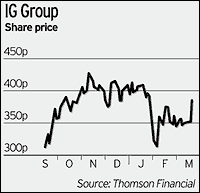
Shares in IG Group, the spread-betting firm, have had a stellar run since the company was refloated on the stock market at 116p in April last year. With the shares at 278p, IG Group is valued at almost £1 billion.
Over the past five years, IG has ridden the boom in spread betting, which offers the chance to bet on falling as well as rising prices. Full-year profits in July jumped by 51% this year and the number of customers rose 26% to 300,000.
IG is adding 1,000 customers a month. Punters are getting more adventurous - five years ago most bets were on equity indexes, now many people take a flutter on commodities and foreign exchange.
The challenge is to maintain the pace. IG is vulnerable if markets are dull, while some analysts have raised concerns that binary bets - allowing punters to gamble on two possible outcomes - have not yet taken off. Even if the market is booming, maintaining growth in Britain of between 40% and 50% looks tricky. That makes expansion abroad crucial.
So far there are signs that it is working. Revenues from the Irish division are up tenfold on last year, while Tim Howkins, the chief executive, reckons the Australian business could be even bigger than the British one. The shares are not cheap at about 20 times earnings, but are still worth holding.
They think it's all over, but it is only just starting for the finance director at spread-betting team IG Group. Tim Howkins is set to be elevated into the chief executive's slot following the announcement that the current holder of the title, Nat Le Roux, will be stepping down.
Spread-betting has taken off big time, with companies such as IG Group benefiting from an apparently insatiable appetite for what is, essentially, a sophisticated form of online gambling.
The original founder was Stuart Wheeler, famed for making a rather hefty donation to the Tories, proof that the man was a born gambler. IG floated in 2000, then was taken private in a management buyout in 2003. It re-floated in 2005, and is due to announce its second full-year results on Monday 24 July.
Le Roux led the buyout, but has now handed over the reins to Howkins, who joined the group in 1999 and was part of the MBO team. And he takes over at a very interesting time. Punters were expected to have placed £1bn in bets on the World Cup, and IG Group will have hoped to grab a slice of the action - as well as betting on share prices, foreign exchange and commodities, IG will take positions in sporting and political events.
So Howkins should have good news to report. Analysts are putting money on a profit spread of between £45m and £50m, which would be up around 40% on the previous year. Its sports business is expected to have grown by 30%, while its 'contracts for difference' business should turn in a growth rate of 60%.
Howkins will also report on the progress of several new initiatives including extrabet.com, an innovative sports fixed-odds service that allows bets to be placed right up to the final whistle. And then there is its binary betting service, which allows you to close out a bet before the sporting action has finished.
But Howkins will need to keep on his toes - recent stock market falls, while benefiting his business through added volatility, have also, ironically, made IG Group vulnerable to a takeover bid. Australian bank Macquaire is rumoured to be considering a punt on the spread-better, though a healthy set of results could push IG's price up and out of its reach.
Spread-betting firm IG Group, confident about its full year as it continues to add customers, said on Friday it hoped to launch a new service for the sports market before the World Cup next June.
IG shares which had risen 5.6 percent this week, were down 3.95 percent at 170 pence by 10:11 a.m.
IG, which allows investors to speculate on currencies, interest rates, shares and indexes, said all its businesses had delivered growth in its first half, the six months to November 30.
"Since the last trading update, the group has continued to experience strong volumes," IG said in a statemen.
IG said its main British financial operation achieved strong growth, "driven primarily by continued high levels of client recruitment", while its Australian business also grew rapidly.
Numis Securities, which rates IG shares a "hold" with a 160 pence target, said the company had clearly made good progress during its first half. "However, given the potentially volatile nature of the business on a month-by-month basis it would be premature to upgrade forecasts just yet."
Plans to offer contracts for difference and foreign exchange trading from a new Singapore base are on track for a January start. "This office is unlikely to contribute materially to the profits of the current year, but is an important step in establishing a presence in Asia and broadening IG's international reach," it said.
IG also said it plans to offer a simplified form of binary betting for the sports market by May. It gave no further details.
Binary betting is a form of fixed-odds betting and thus has limited risk and limited reward, unlike spread betting. Prices are quoted between 0-100 instead of, say, 2/1 or 3/1.
A typical bet would be on whether the FTSE 100 index will close higher on a given day. Unlike spread betting, the number of points the index actually rises or falls is immaterial.
IG was refloated in April at 120 pence per share, having been taken private by its management in 2003 in a 143-million-pound deal backed by private equity firm CVC.
In July, it reported a 40 percent rise in underlying annual profit to 35.1 million pounds for the year to end-May.
IG shares have outperformed their sector by 14 percent since their Apr. 28 flotation.
Spread-betting specialist IG Group reported a strong rise in profits - in its maiden full-year results since returning to the market at the end of April - helped by a 23 per cent rise in the number of clients. More than 85 per cent of all financial deals are now transacted on two electronic platforms, compared with 20 per cent at the beginning of 2003. Internet clients are easier to recruit and tend to trade more frequently. Income per client rose by 2 per cent to £2,387.
Business was especially brisk in Australia, where turnover jumped 165 per cent to £3.8m, and now accounts for around 6 per cent of group turnover. The contracts-for-difference business (CFDs) performed strongly, too, helped by development of the L2TM direct-market-access dealing platform for clients. Turnover in financial binaries rose by 130 per cent, and this has been identified as the fastest growth area of the business. In short, this form of betting means that a client can back or lay off a fixed-odds bet before settlement, enabling the whole position to be closed out at an early stage if required.
Numis Securities is forecasting pre-tax profits of £39.6m, adjusted EPS of 8.3p and a dividend of 4.1p for the year to May 2006, rising to profits of £45.1m, EPS of 9.4p and a dividend of 4.7p the year after.
IG GROUP (IGG) Share price: 149pCity betting firm IGIndex was yesterday poised to go private after major shareholder Stuart Wheeler agreed plans to sell his stake in the firm he founded.
Mr Wheeler's 24pc holding is expected to net him £34m after managers - headed by chief executive Nat le Roux and backed by private equity firm CVC Capital - offered 255p a share, valuing IG at around £143m.
The 67-year-old previously said he would use the cash gained from the sell-off to fund the refurbishment of his 17th-century manor house in Kent.
The agreed price represents a premium of 40pc to the closing price of 181.5p a share on the last day before Mr Wheeler's January announcement that he planned to dispose of his interest in IG.
IGIndex, the spread betting firm, which offers punters the chance to wager on financial markets, house prices and sports, said its independent directors had concluded the offer represented the most attractive means of realising value for shareholders.
Several bidders were reported to have been circling IG between the sale being announced and the firm going into exclusive discussions with CVC and the management bidders.
Poker-playing millionaire and Old Etonian Mr Wheeler is best known for his £5m donation to help the Conservative Party fight the 2001 General Election.
Reporting full-year results to May 31, IG said turnover had risen 20pc with pre-tax profits of £15.3m.
The content of this site is copyright 2016 Financial Spread Betting Ltd. Please contact us if you wish to reproduce any of it.

