


Open interest is a term used in futures and options, and is a count of the number of contracts outstanding. You will recall that futures or commodities are traded with a large amount of leverage or gearing, which means you do not have to pay for the goods that you are contracting for. In fact, most futures traders have no intention of fulfilling the contract that they take out. Although the futures market was set up as a form of hedging for farmers and producers, speculation is a much larger use of futures contracts nowadays.
At the end of each day there are many future commitments represented in futures contracts, and these all represent transactions that must take place some time. While most traders will not go through with the contract, the contracts are still in existence unless both parties have cancelled them with an agreed payment and they must be completed by whoever holds them at the expiration date. Open interest is commonly plotted as a line under the price chart but above the volume bars, or it can be overlaid on the volume or price charts. Below you see the open interest line, in pale blue, over the darker blue volume bars. This is a chart of Light Sweet Oil futures.
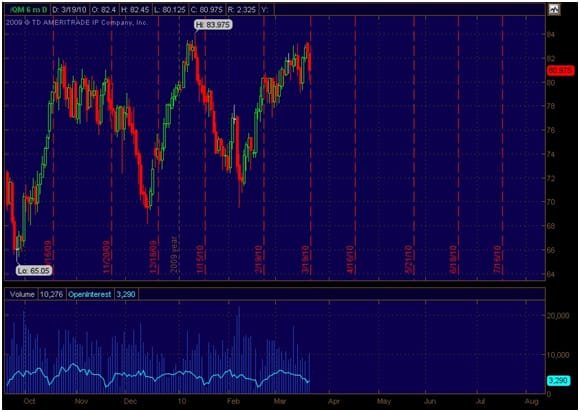
You can see how typically the open interest dips down at the contract expiration dates, which are shown by red dashed lines. Obviously, contracts are often settled at those times, so the number of open contracts reduces. Note also there are some high-volume trading days which make little or no difference to the open volume.
As noted above, official volume and open interest figures are reported one day late and therefore are lagging by one day. So on a daily basis, you can plot the high, low, open, and close for the price, but the volume and open interest numbers are for the previous day and price bar or candlestick.
One point it is very important to note is that the open interest represents the total number of longs or shorts outstanding, and not the sum of them. Open interest is the number of contracts, and each contract has both a buyer and a seller, so two market participants make only one contract. The change in the total open interest figure each day, whether up or down, is an important indication of the mood of the market.
Now here’s another complication with open interest. Every time there is a trade in the particular futures contract, it can affect the open interest in one of three ways – the open interest can increase, it can decrease, or it might stay the same. It all depends whether either trader was already in the market, and is just getting out of the position, or whether it is a new position for them.
The open interest will stay the same if one of the parties to the contract is liquidating an old position, which to the other party is a new holding. Effectively it’s the same contract with a different owner. The seller can sell an existing long position to the buyer who wants to open a long position. The same with a short position, except the seller is the one entering the new (to them) contract because it’s short – you buy long and sell short.
The second case is when both traders were not in a contract before. In this instance, the buyer would buy a new long and the seller would sell a new short, increasing the open interest by one. As noted above, this is one contract with two participants.
If both traders were already in a contract, one long and one short, and they wanted to liquidate their positions, then the total number of contracts will decrease by one. Subject to agreeing on the value of the contract, the open volume would go down.
So when you look at the open interest each day, and whether the total number of contracts has increased or decreased, you are getting a strong sense of how much money is flowing into or out of the market.
