


The Strength of Support and Resistance
You may be wondering to what extent you can trust and expect support and resistance to work. Obviously, if you can trust them to hold firm the majority of the time, say 80% of the time that they are tested, then you can base your trading on the assumption that they will stand. That would make a big difference to how profitable your trading will be.
Of course, there is no easy answer to this, as different financial securities, different markets, and different levels will all show varying amounts of strength, defined as the ability of the support or resistance level to deflect the price. Some levels hold for a long time, and others are hardly established before they are broken. It depends how solidly they are established by the market. You can gauge this in several ways.
Firstly, you can see how many times the level has been challenged by the price, and caused a rebound. If the level has been tested on several occasions, then it is more reliable than one touch and retreat. It is plain that if the level has withstood many challenges in the past, it should resist them strongly in the future. This comes under the self evident category, and is helped by other traders looking at the same charts and believing in the strength of the levels, making it to some extent self-fulfilling. It is also easier to identify where the levels are when the price has been there a few times, which makes your analysis easier. Just look back at the last chart – the support is very easy to see.
Secondly, how long the stock has been trading up to the levels is a sign of the solidity. In the chart above, the stock has been between the support and resistance for several months, which means the levels are more valid than if it had been trading there for a few days. Once again, the level is considered more established, and more accepted and expected by other market participants.
Next, as you might expect, if there has been heavy volume trading on those levels they are more established than if not. It’s hard to see if that applies to the previous chart, as a couple of peaks cause the scale to be hard to read. Heavy volume is effectively a vote in favour of a level, once again giving self fulfillment. There is a spike in September which coincides with one of the support reversals.
Another indication of how well the support and resistance levels may prevail is how recently they have been tested. The more recent any activity is, the more likely it is to hold up to further testing. Short-term memory by the market, or more correctly by the market participants, will give a more certain response.
The previous points seem logical, if not expected. What you may not anticipate is that support and resistance are often at round numbers, such as 10, 20, 30, 50, and 100. The Dow Jones Industrial Average frequently stops or hesitates on multiples of 1000. This has been observed often, with a variety of securities and indices.
There’s no real technical reason for this, just psychology, the way people think. It’s even more amazing when you consider that the DJIA is made up of 30 different share prices, added together with different weightings. As illustration, here’s a chart of the Dow –
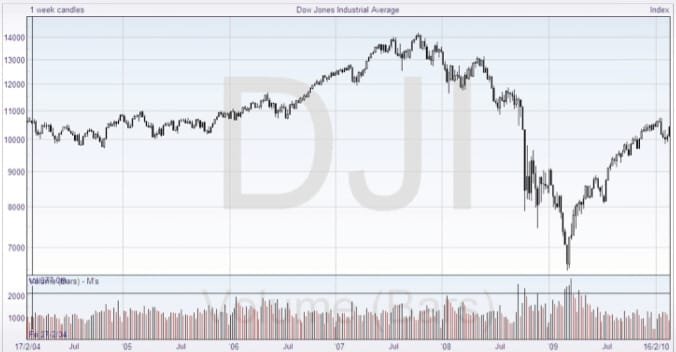
You can see that in 2005 and 2006 the index hit 11000 and bounced off, taking it as a resistance. At its peak, the Dow seemed to range between 13,000 and 14,000. In July 2008 11000 was revisited, becoming a support level for a month, before the financial crisis caused the index to plunge further. 10000, 12000 and 13000 also have prices bouncing against them.
How do you use this information? One way is if you want to buy or sell, when you should avoid placing your orders right at these or similar round numbers. There’s a chance that your order may not be filled. Far better to place your order just before the price reaches the level, and then you are more likely to find that the order goes through. This applies whether you are trying to get into the market or placing a protective stop.
Join the discussion